This past weekend was all about “firsts” in my life.
First time to fly Delta
First time in the Detroit airport
First time to visit South Bend, Indiana
First time to see the Notre Dame campus
And above all my first time on TV
 Dena, my co-author and dear friend, flew to
South Bend to interview on The Harvest Show. I must say, I was excited up to
the point I stepped on the platform of the stage. At that moment my excitement turned to
fear and anxiety. I felt like a deer in headlights. Though I heard the
questions, my mind fell into a big cloud and I could hardly answer. To
this day, I have no idea what questions they asked because everything seemed a big blur.
Dena, my co-author and dear friend, flew to
South Bend to interview on The Harvest Show. I must say, I was excited up to
the point I stepped on the platform of the stage. At that moment my excitement turned to
fear and anxiety. I felt like a deer in headlights. Though I heard the
questions, my mind fell into a big cloud and I could hardly answer. To
this day, I have no idea what questions they asked because everything seemed a big blur.
In an instant I reminded myself that the show was broadcast internationally. Suddenly I felt exposed to the entire world. The interview started, questions came, but- to use the football analogy - I fumbled the ball.
I could not recall details, names, and heart felt thoughts I wanted to share. I tripped through the answers
and felt as if I went down with a hard blow to the chest. There was so much I
wanted to say but didn’t - or couldn't.
 Being my very first TV interview (and my second interview ever!), I should have
researched what to do, where to look, and how to speak. Dena coached, but some things are learned best through experience and this was one of those
moments.
Being my very first TV interview (and my second interview ever!), I should have
researched what to do, where to look, and how to speak. Dena coached, but some things are learned best through experience and this was one of those
moments.
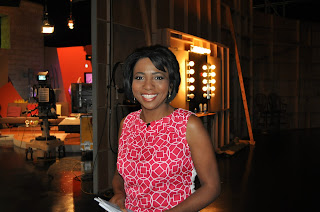 Our host, Valarie, was amazing and incredibly
uplifting and encouraging. She helped us feel as comfortable as she could.
Still, I came away feeling terrible about the interview and as if I had let everyone down; as if I had let myself down.
Our host, Valarie, was amazing and incredibly
uplifting and encouraging. She helped us feel as comfortable as she could.
Still, I came away feeling terrible about the interview and as if I had let everyone down; as if I had let myself down.
The next day Dena left earlier than me to catch her
plane. Heavy despair draped my soul as I wondered from one end of the room to
the other to gather my things. It’s easy to beat ourselves up over things and that was
exactly what I did. If it had been a physical beating I would have been
black and blue.
At some point I stopped and decided to find
something on TV that would redirect my thoughts of how I was feeling. I picked up the remote
and clicked through the channels. Suddenly I heard, “Listen! God uses people
all the time who have no idea what they’re doing!” I stopped as Joyce Myers
continued speaking. In that moment it was as if God was yelling out at me – “Listen!
I use people all the time who have no idea what they’re doing!”
Joyce went on to say, “Don’t under estimate the
power of God and what He can use.” I
took in a deep breath and began my quest to try to straighten out my mind Satan
had so elegantly twisted.
Truth – God can use anything He wants to use but it
does help to be prepared. I can say I wished I had better
prepared myself for what to expect from a television interview. The least I can do is
share my experience and know that the next time- I will be in a much better
place.
1.
Make and hold eye contact. Focus on the person asking the questions and
not on the camera. The more your eyes move around, the more uncomfortable your
audience will become. The underlying message is that you are either trying to
hide something or you are unsure of yourself. A powerful, steady gaze speaks
volumes about your trustworthiness.
(It was difficult for me to keep focused on the host and not look at the monitors or cameras - especially if the host is reviewing her next question on the teleprompter. I also felt confused as to where to look when Dena was speaking - do I turn and look at her or keep focused on the host?)
2.
Ensure that however you look is aligned with
how you want to be perceived. If your message is sober and serious, dress in a dark suit. If
you want to be seen as hard working, roll your sleeves up. If your message is
fun and informal, you can probably leave the suit at home and wear a golf
shirt.
(Well - I got this one wrong too. I dressed in a dark black suit with a plum shirt. I was dressing for the camera rather than trying to find something that helped me feel comfortable and good about myself.)
3.
When sitting during an interview, sit up and lean forward slightly when you
talk to open up your diaphragm, increase your air supply, prevent you from
slumping and make you look engaged in the discussion. Do not relax or let your
back touch the back of your chair. You need to be "on" at all times.
(Though Dena shared this with me, I fidgeted during the entire interview and worried whether I was sitting up straight enough, whether my clothes were hiding all the areas I didn't want to show, and whether I was taking deep breaths. Whew! That's enough to distract anyone. I realized I needed to find a comfortable place to sit and just do it.)

4. You have just a few seconds to sell your story.
Studies have found that the average TV sound bite is around seven seconds long.
Practice with a stopwatch in front of your bathroom mirror. By practicing out loud you can get rid of
audible pauses such as "um, "like" and "you know."
(Of course I didn't practice in the mirror but was told by Valarie (our host) that she used to practice in the mirror and that's how she became comfortable in speaking. If I ever get another opportunity, I will truly take this one to heart and practice, practice, practice.)
5.
Brainstorm likely questions as well as worst-case-scenario questions. If
you spend some quality time really thinking about it, you should be able to
anticipate 85 percent of the questions. It’s tougher -- though not impossible
-- to come up with the crazy questions that come out of left field, but it’s
worth spending time thinking about them and practicing ways to respond.
(Though we did not go over the questions we were going to be asked, Dena and I did briefly go through some questions the night before. But what I didn't do was spend a good amount of time thinking through answers to questions that might be asked. I also didn't practice responses. I realized it doesn't matter how well you think you know your subject - practice is beneficial and thinking through every element of your topic is extremely helpful. Practice recalling names, title, words, and so on)
6.
Define your key messages and be ready to deliver those messages
regardless of the questions you’re asked. Acknowledge any questions you’re
asked, but always bridge back to your key messages during an interview. Also,
reiterate those messages if you’re asked to provide a sound check or give a
closing thought.
(This is such great feedback! What was the message we wanted to give and did we do a good job of releasing the message to the world? Dena did so much better at sticking with the message of hope and healing than I did. Lesson learned. This small thought can become the biggest star in your interview.)
7.
Turn off cellphones and Blackberries, spit out the gum, remove coins from pockets,
don’t hold a pen and ask the technician to turn off the TV set by the camera so
you’re not tempted to see how you look during the interview. Also, avoid chairs
that swivel and rock. They are too tempting, especially when you get nervous.
8.
Spend time beforehand identifying specific
examples that help make your message personal. You can help journalists tell their story by
using examples, anecdotes and graphics. Telling stories also helps break your
conversation into sound bites.
(I'm a great story teller - it's what I do. However, because I was so nervous I couldn't get any stories out. What would have helped me was to connect stories with names and messages with certain triggers. If I had really gotten that part down, it would have been like a test and been easier to recall those things I wanted to share.)
9.
Recognize that anything can happen in TV news, so be prepared and try to accommodate any
unexpected changes. Don’t be phased if an in-studio interview changes to a
satellite hookup or an interview that was supposed to be taped suddenly is
carried live. Flexibility is a must.
10.
Be an active participant. Television observes everything, especially
posture, energy and facial expression. Watch the delivery of TV news anchors
and you''ll see how much they accentuate what they say with unspoken cues. If
possible, take a brisk walk before going on camera to get your blood flowing
and wake yourself.
 (Believe me - when the lights hit and the count down gets to 1 - you wake up! You may not be coherent but your heart is surely beating.)
1. Preparation
Whether you are
giving a pre-recorded telephone interview for two minutes or appearing in a
live TV studio for an hour, it is essential to properly prepare for your media
appearance.
Make sure you
are clear about your subject and think carefully about the key messages you
want to convey. Concentrate on three points that you want to get across – you
will be surprised how quickly the time goes so anything else will be a bonus.
Understand the programmer’s
audience and tailor your message accordingly. Make sure you have an awareness
of what else is leading the news agenda in case you are sprung with a topical
question on an unrelated issue.
Ask who will be
interviewing you and if you will be appearing with any other guests, so you can
research their backgrounds. Check the producer has your correct job title and
company name.
2. Presentation
Wear something
that is comfortable and smart. This is not the day to experiment with a dress
or top that is too tight. Avoid fussy patterns such as dog tooth, which play
havoc with the TV cameras or black or white, which drains color from your skin.
Go for complimentary tones. Don't wear bulky or excessive jewelry as this will
distract viewers. Do not wear anything too short as you may sit on a low
sofa or seat. Cross your legs at the ankles rather than the knees.
3. Confidence
Appear
confident even if you are a nervous wreck inside. No one is going to believe in
what you are saying if you don't believe it yourself. Take a nice deep breath
before you speak. Your breathing and speaking rate should be steady and calm so
you have time to think about what you are saying. This will help to avoid those
awkward "ums" and "ahs".
Try not to
interrupt the presenter or other guests – especially on radio. Your turn will
come. Stay still and try not to move your head too suddenly. Hand gestures can
help you make your point but try not to use them excessively.
Don't get
over-confident and remember that the camera and microphones will be on even
when the interview has finished. You will have seen many politicians caught out
this way. Most importantly, smile and be yourself.
4. Punctuality
Schedule in
plenty of time. Women can take up to half an hour in makeup and hair, so get to
the studio earlier than you need to.
Above all - whatever happens, don't beat yourself up or allow Satan to steal from you. Know that God can take, what we think are messes, and turn them into His greatest messages.
May Your Television Journey End in a Wonderful Experience


